
A Joint Policy and Budget Agenda for New Yorkers with Intellectual and Developmental Disabilities

Supporting people with intellectual and developmental disabilities (IDD) requires modern policy, a stable workforce, and sustainable investment.

What we’re doing:

We’re asking lawmakers to make common‑sense changes that keep people safe, ease the burden on families and staff, and make care more dependable. Our priorities focus on better access, modern tools, and support for the people doing the work every day.

Why it matters:

When care is easier to deliver and easier to receive, people stay healthier, families feel supported, and our communities thrive.
Individuals with intellectual and developmental disabilities deserve better. Their families deserve better.

It’s time to invest in dignity, equity, and the future of community-based care.

75% of New Yorkers with IDD live in the community, yet only 30-35% of the budget is allocated for these non-certified settings.

Provider agencies face persistent workforce shortages, rising costs, and aging infrastructure.

Outdated rules designed for an institutional system limit flexibility, drive inequity, and raise costs.

Families are absorbing the strain and fear for their children’s uncertain futures.

Our Hopes for System Change Are Simple:

  • Modernized rules and regulatory flexibility that support independence and innovation

    • Updating nurse practice laws and housing regulations to reflect current realities and person‑centered values.
    • Removing barriers that limit choice, innovation, or the use of technology in community‑based care.
  • Strengthened families through recognition, training, and compensation

    • Empowering trained family members to provide complex care at home, stabilizing families and reducing reliance on costly institutional or emergency services.
    • Protecting caregivers from burnout while improving quality and consistency of care.
  • A supported, sustainable workforce that can afford to stay in the field

    • Investing in equitable DSP wages, affordable housing, childcare, and health care supports to reduce turnover and improve continuity of care.
    • Ensuring agencies can recruit and retain the workforce needed to meet demand.
  • Coordinated, integrated care for people with both IDD and mental health needs

    • Modernizing the care coordination model (CCO+) to integrate behavioral health, medical care, and developmental disability services—reducing ER visits, crises, and hospitalizations.
    • Ensuring that individuals with co‑occurring needs get timely, specialized support.
  • Smart public investment that reduces crisis, lowers costs, and aligns with NYS priorities

    • Data‑driven Medicaid spending, capital investment for housing infrastructure, and policy modernization that matches NYS goals around economic stability, health equity, and climate sustainability.
    • Shifting from reactive crisis funding to proactive, preventive system building.

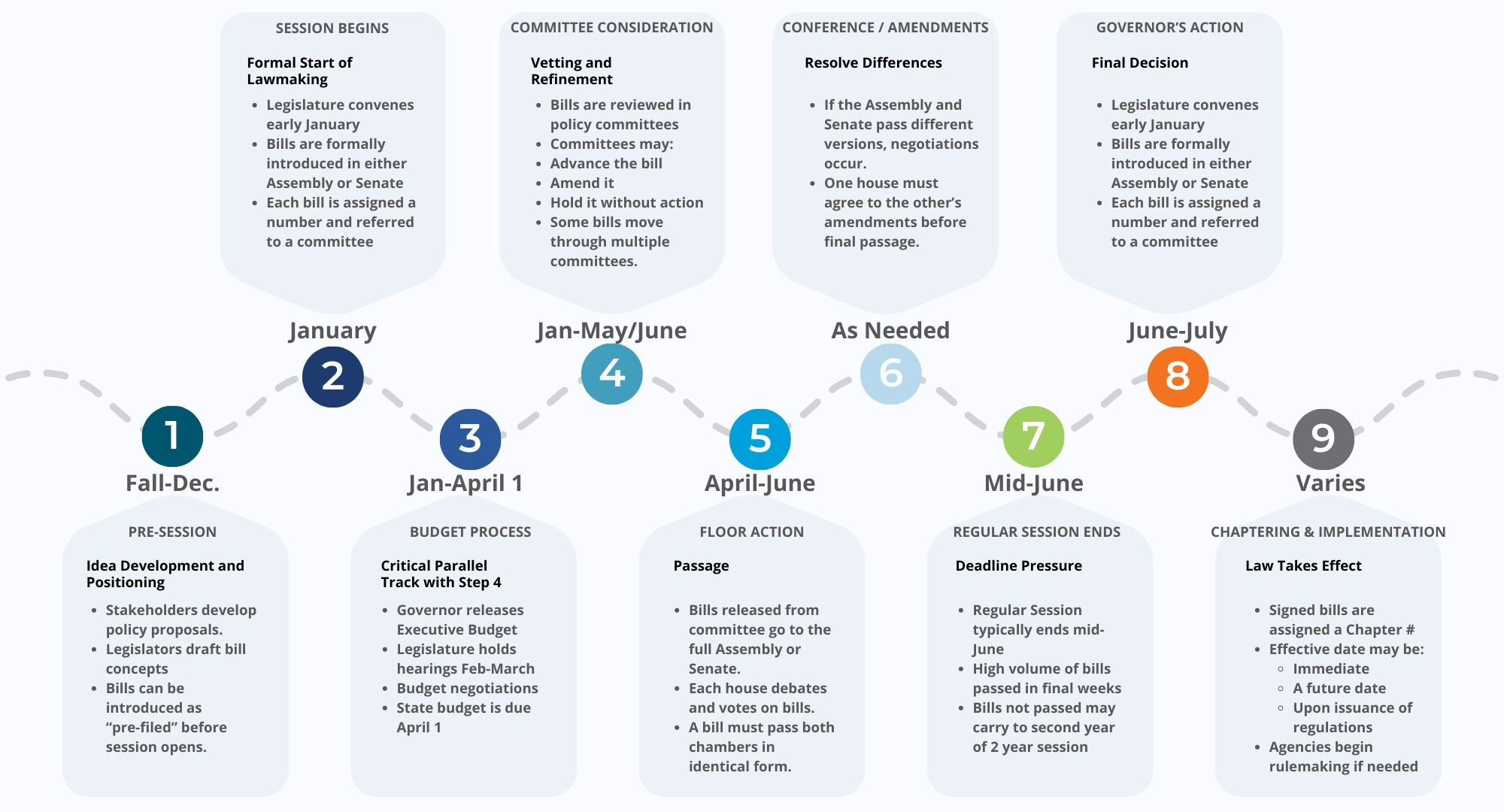
NY State’s Legislative Timeline

Click on the steps below for more detail:

  • Stakeholders develop policy proposals
  • Legislators draft bill concepts
  • Bills can be introduced as “pre‑filed” before session opens
  • Legislature convenes early January
  • Bills are formally introduced in either Assembly or Senate
  • Each bill is assigned a number and referred to a committee
  • Governor releases the Executive Budget in January
  • Legislature holds hearings through February and March
  • Budget negotiations dominate legislative priorities
  • State Budget is due April 1
    • Many major policy decisions are enacted through the budget
  • Bills are reviewed in policy committees
  • Committees may:
    • Advance the bill
    • Amend it
    • Hold it without action
  • Some bills move through multiple committees
  • Bills released from committee go to the full Assembly or Senate
  • Each house debates and votes on bills.
  • A bill must pass both chambers in identical form.


  • If the Assembly and Senate pass different versions, negotiations occur
  • One house must agree to the other’s amendments before final passage
  • Regular session typically ends mid‑June.
  • High volume of bills passed in the final weeks.
  • Bills not passed may carry over to the second year of the two‑year session.
  • 10 days (while Legislature is in session) to:
    • Sign the bill into law
    • Veto it
  • 30 days if the bill is passed after session ends.
  • Governor may issue:
    • Approval memo
    • Veto message
  • Signed bills are assigned a Chapter number
  • Effective date may be:
    • Immediate
    • A specific future date
    • Upon issuance of regulations
  • Agencies begin rulemaking if required
young woman smiling

Advocacy Toolkit

  • Messaging
  • Dear Legislator letters
  • One Click
  • Resources
  • Pre-written social posts WITH OUR HASHTAGS
  • HASHTAG LINKED TO US

Document Library

customer service agent

Contact Us/Media Inquiries

Who is the contact